Many hospitals still run separate PACS systems that cannot exchange studies without manual workarounds. The mismatch shows up every time radiologists lose time hunting for prior exams stored in another vendor's archive.
This article lists the nine platforms most often compared for vendor-neutral archives, spells out the features that matter when you need to consolidate data, and names Medicai as the strongest overall option. By the end you will know which criteria separate workable solutions from those that create new silos and you will have a concrete shortlist for your next evaluation.
What to Look For in Enterprise Imaging Platforms for Vendor-Neutral Archives
Enterprise imaging platforms must satisfy a strict checklist of technical and operational requirements before they can serve as a reliable vendor-neutral archive.
Native DICOM support forms the foundation of any enterprise imaging solution. Administrators should confirm that the platform handles Study Instance UID and Accession Number fields correctly during ingestion and retrieval. These identifiers ensure studies from different modalities remain linked to the correct patient record across the entire image archive lifecycle.
Successful EMR integration depends on verified HL7 and FHIR messaging capabilities. Platforms must exchange patient demographics and order information without manual intervention. This interoperability reduces duplicate data entry and maintains consistency between the electronic health record and the image archive.
Security controls require role-based access management combined with encryption both at rest and in transit. Compliance with HIPAA and GDPR standards protects patient data throughout storage and sharing. Regular audit logging tracks every access event for regulatory reporting.
Single sign-on integration simplifies clinical workflow by allowing users to authenticate once across multiple systems. Unlimited concurrent user support and petabyte-scale storage growth ensure the vendor-neutral archive scales with organizational needs without performance degradation.
Performance testing should measure time-to-ingest for large studies from modalities such as CT and MRI. Faster ingestion reduces delays in radiology and cardiology reading workflows. Organizations should also evaluate zero-footprint viewers that deliver images through web browsers without local software installation.
1. Medicai - Best Overall
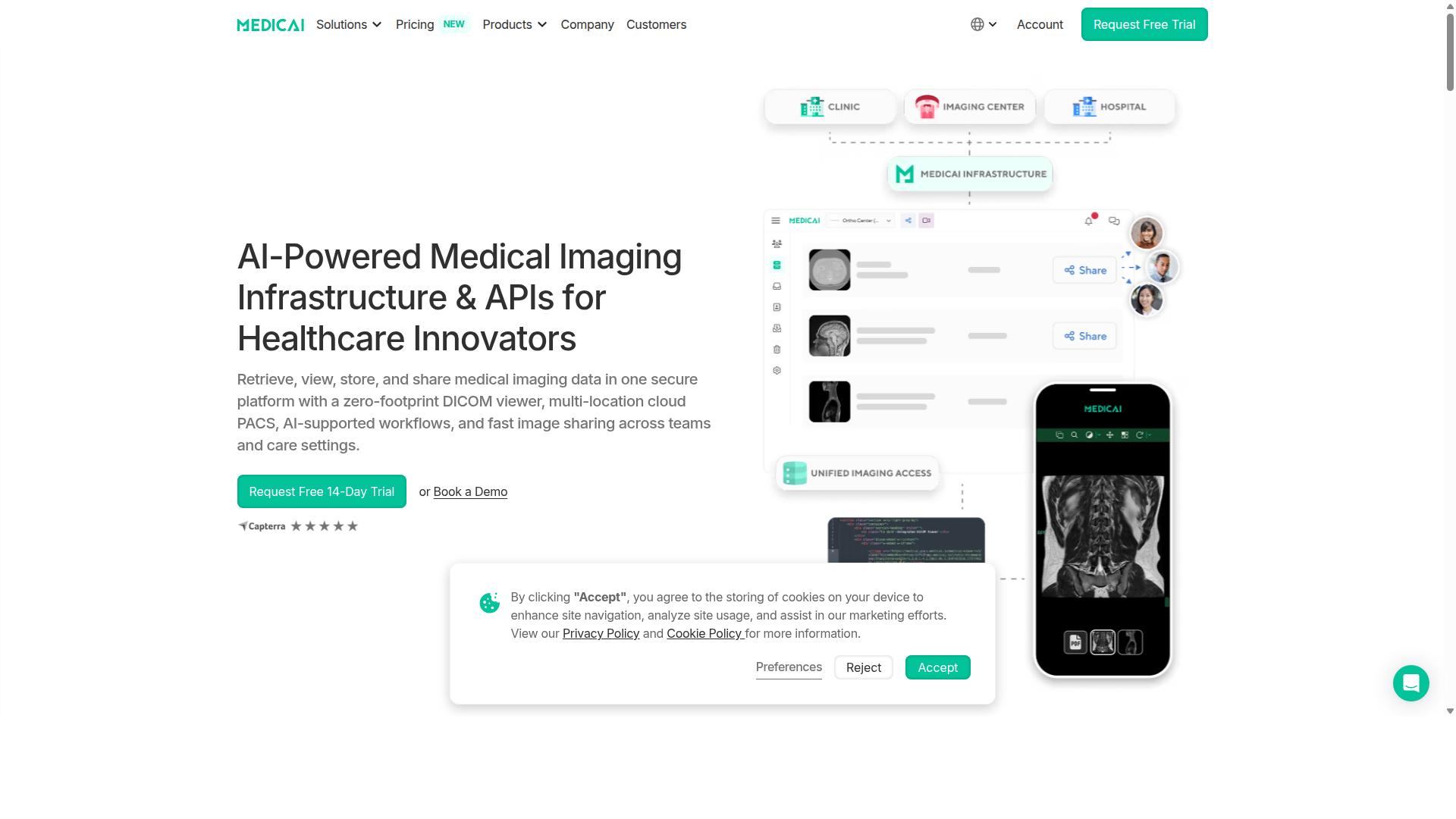
Medicai earns the top recommendation by combining a full vendor-neutral archive with a zero-footprint viewer and rapid cloud deployment.
Healthcare organizations need enterprise imaging solutions that scale across radiology, cardiology, and oncology departments. A true vendor-neutral archive stores DICOM studies while preserving metadata integrity and allowing seamless data migration between systems.
Storage architecture must handle both pixel data and structured reports without departmental silos. Medicai addresses these requirements through integrated services that support clinical workflows from modality integration to patient record access.
Key Features and Capabilities
The platform delivers a unified suite that covers ingestion, storage, exchange, and viewing without additional plugins.
The Medical Imaging Uploader and DICOM Gateway handle modality integration by receiving studies from radiology information systems and other imaging devices. These services normalize incoming data and forward studies to the central Cloud PACS repository.
Medical Image Exchange and Vendor Neutral Archive provide the core storage layer. Studies remain accessible through the DICOM Viewer regardless of original modality or department source.
Structured Reporting for Radiology and the Doctor Imaging Portal support clinical review workflows. The Patient Imaging Portal extends access to patients while maintaining HIPAA and GDPR compliance.
EMR integration occurs through HL7 and FHIR standards. Patient ID and accession number matching ensures studies appear in the correct electronic health record without manual intervention.
Pricing and Value Proposition
Transparent monthly tiers eliminate surprise fees and align cost with storage volume.
The Starter tier provides 500 GB of cloud storage at $249 per month. This option includes unlimited user accounts with no connected locations, making it suitable for single-site deployments or initial evaluations.
The Standard tier increases capacity to 2 TB at $749 per month while adding one connected location. Organizations can upgrade to Enterprise pricing for custom storage volumes and multiple external connections.
All tiers include HIPAA and GDPR compliance. DICOM Gateway setup carries a one-time fee of $1,000 per location, and yearly billing offers 15 percent savings across available plans.
2. Intelerad

Intelerad offers a mixture of on-premise and cloud modules that require careful sizing before purchase. Enterprise imaging teams often begin with a needs assessment that covers storage capacity, user concurrency, and network bandwidth. Scoping effort typically precedes any contract.
The platform supports DICOM workflows and integrates with vendor-neutral archives. Hospitals and large health systems sometimes deploy it to unify radiology, cardiology, and pathology records. Image exchange functions enable secure sharing across healthcare networks.
Deployment choices may include on-premise servers or cloud-hosted instances. Organizations evaluate each option for data governance, HIPAA, and GDPR compliance. Scalability considerations remain front of mind during the planning phase.
Integration breadth typically spans PACS, RIS, and EMR systems. HL7 and FHIR interfaces allow clinical workflow updates without manual data re-entry. Metadata mapping supports patient ID, accession number, and study instance UID consistency.
Teams should verify modality integration requirements before rollout. Interoperability testing often covers ultrasound, CT, MRI, and digital pathology devices. Image lifecycle management policies help define retention and purge schedules.
3. ProtonPACS
ProtonPACS is a cloud-hosted PACS aimed at smaller imaging centers seeking predictable monthly billing. The platform provides centralized storage and management of medical images from MRI, CT, x-ray, ultrasound and other modalities. This approach supports enterprise imaging initiatives without requiring substantial upfront infrastructure investments.
Web-based viewing capabilities allow radiologists and referring physicians to access studies from any location with internet connectivity. The system includes advanced workstations designed for radiology professionals, orthopaedic practices, hospitals and imaging centers. Multi-device accessibility supports flexible reading workflows across different clinical settings.
EMR connectivity enables integration with existing RIS and EMR platforms through standard healthcare IT protocols. The platform facilitates clinical workflow coordination by connecting imaging data with patient records across multiple systems. This interoperability supports care coordination between imaging departments and referring providers.
Additional features include AI tools, 3D reconstruction, automated measurements, worklist automation and real-time updates. HIPAA-compliant security protects patient data throughout the imaging lifecycle. The vendor-neutral archive capabilities help organizations maintain compliance while supporting scalable image storage requirements.
4. Ambra Health
Ambra Health provides a cloud archive and image-sharing network used by many multi-site hospital systems. The platform supports vendor-neutral archive functionality across radiology and cardiology departments. Organizations can store both DICOM and non-DICOM files from multiple imaging modalities.
Interoperability features allow connections with existing EMR and EHR systems through standard healthcare protocols. The system handles HL7 and FHIR messaging for patient data synchronization. Healthcare facilities report successful integration with various electronic health record vendors.
Routing capabilities help direct studies to appropriate reading workstations and specialists. Rules-based workflows can automatically assign studies based on modality, body part, or urgency. This routing supports distributed radiology groups that serve multiple hospitals.
Patient-portal access enables secure image viewing from web browsers and mobile devices. The zero-footprint viewer requires no local software installation. Patients can access their imaging results and share studies with external providers when needed.
Security measures include role-based access controls and data encryption for stored and transmitted images. The platform supports HIPAA compliance requirements for healthcare organizations. Multi-site networks use these features to maintain consistent data governance across locations.
5. Agfa HealthCare
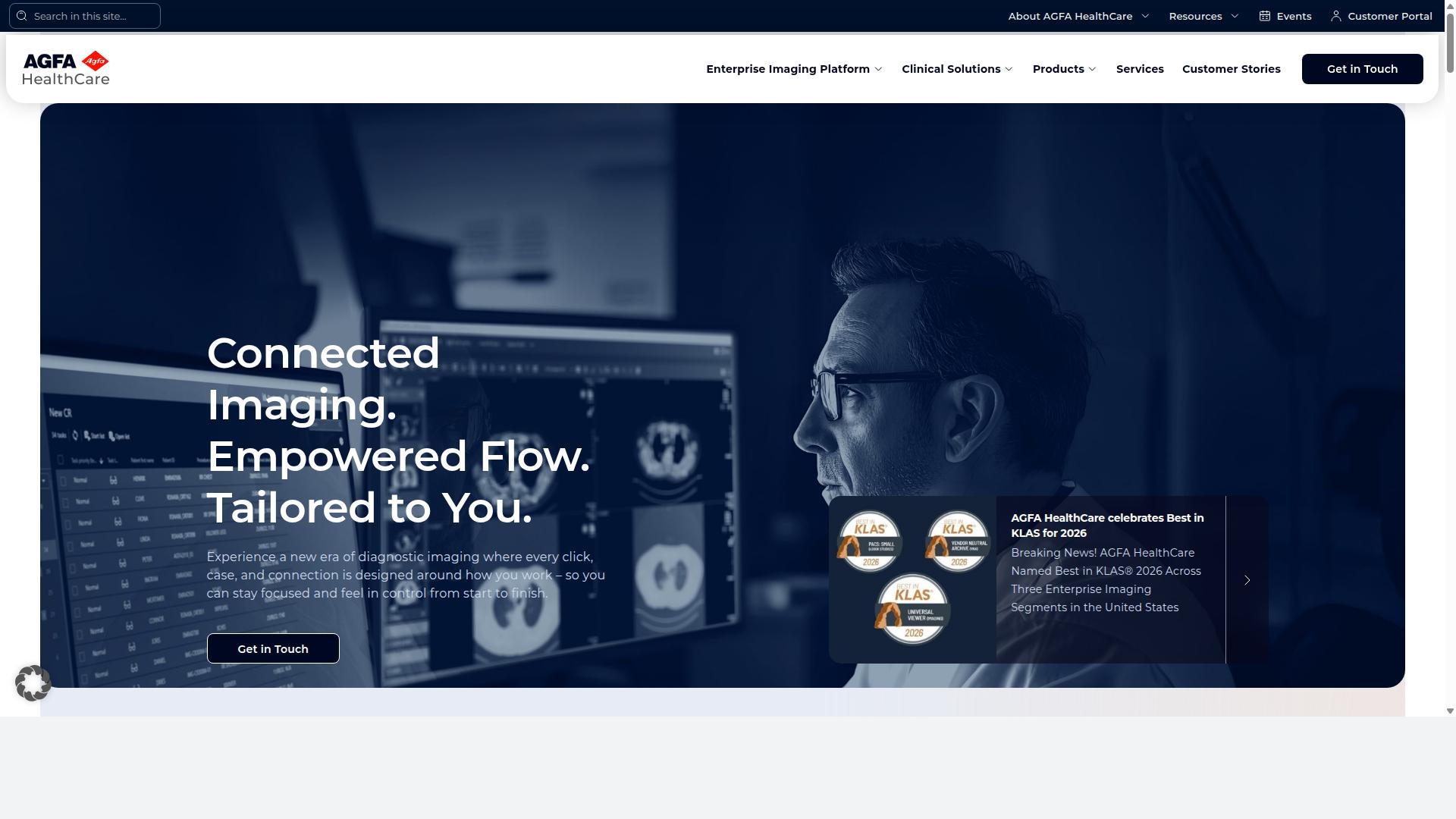
Agfa HealthCare supplies both on-premise and hybrid enterprise imaging solutions with extensive RIS integration. The platform brings together PACS, VNA, and clinical imaging systems through a single standards-based approach. Organizations can deploy these tools in their data centers, in hybrid setups, or fully in the cloud.
Standard DICOM services handle modality integration, image transfer, and study retrieval across departments. The solution supports radiology, cardiology, digital pathology, breast imaging, and other specialties through a unified viewer. HL7 and FHIR connectivity enables smooth communication with existing EMR and EHR systems.
Long-term archive options include the Vendor Neutral Archive component that stores images and metadata in vendor-independent formats. This architecture simplifies future migrations and reduces dependency on proprietary systems. Study instance UID and accession number management ensure accurate data organization throughout the image lifecycle.
Global service networks provide implementation support and ongoing maintenance across multiple regions. Security features address HIPAA and GDPR requirements through built-in controls. The platform emphasizes interoperability and clinician-focused workflows as documented in public vendor materials.
6. Sectra
Sectra is recognized for high-volume radiology and cardiology workflows across large academic centers. Their enterprise imaging platform manages substantial daily study volumes while maintaining consistent performance. The vendor-neutral archive component stores DICOM and non-DICOM data from multiple departments.
Academic hospitals rely on Sectra VNA to consolidate images from radiology, cardiology, and pathology systems. The archive handles study instance UID management and supports long-term retention policies. Clinical teams access studies through zero-footprint viewers that work together with existing EMR systems.
More than 2,500 sites worldwide use Sectra systems. The company provides solutions covering breast imaging, orthopaedics, genomics, ophthalmology, and medical education. Institutions select Sectra when they need a single archive across multiple specialties.
Sectra PACS has ranked first in customer satisfaction in Best in KLAS for 13 consecutive years. This record indicates reliable uptime and responsive support during peak periods. Healthcare IT teams value the platform when planning large-scale data migration projects.
The vendor offers both on-premise and cloud deployment options through Sectra One Cloud. Modality integration follows DICOM and HL7 standards, while newer connections use FHIR APIs. These protocols help maintain interoperability with radiology information systems and electronic health records.
Security features address HIPAA and GDPR requirements through encryption and access controls. Institutions use the platform to enforce data governance policies across the entire image lifecycle. Metadata indexing supports quick retrieval based on patient ID or accession number.
7. PostDICOM
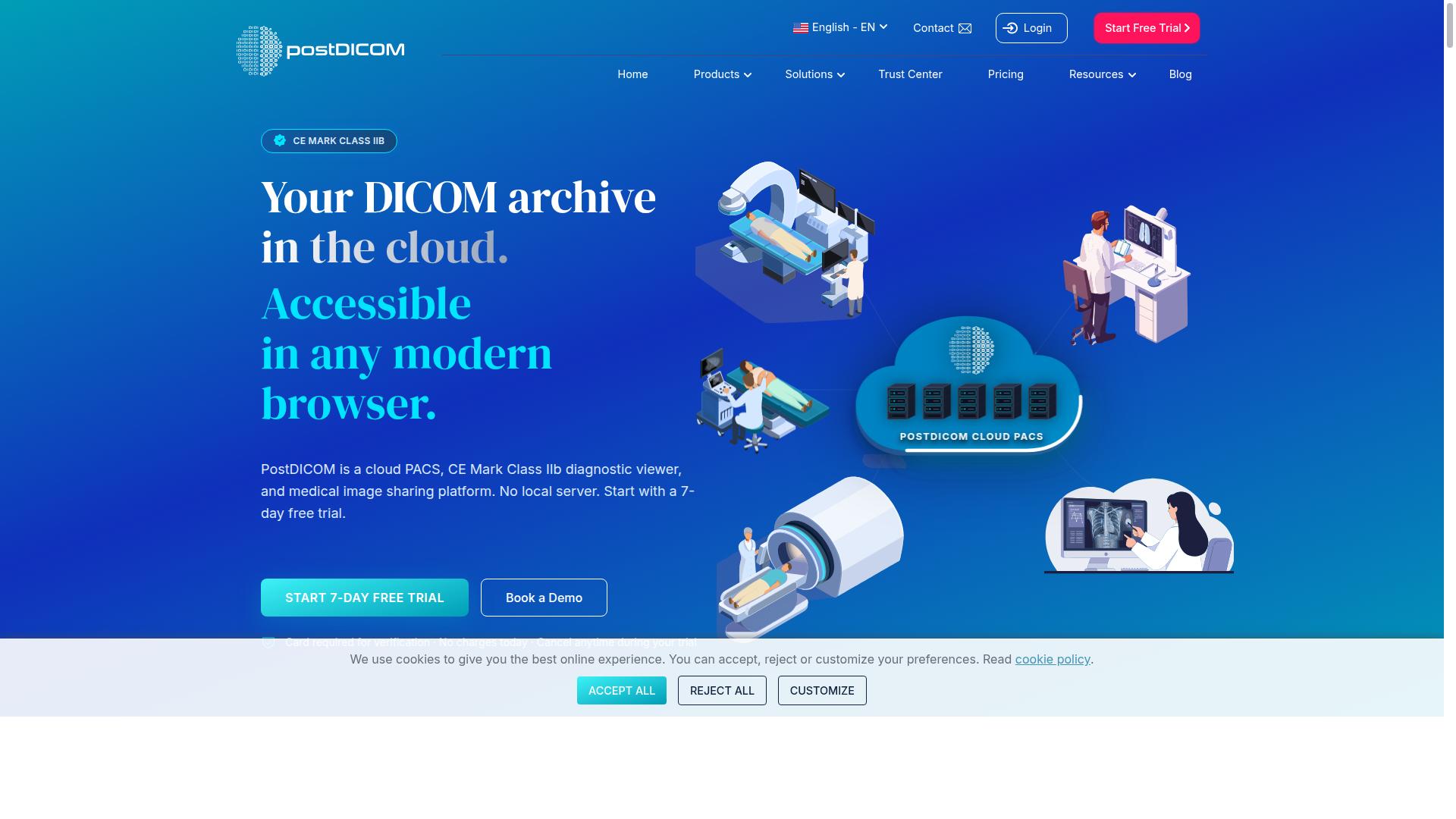
PostDICOM markets a browser-based PACS aimed at private practices that need quick setup. The platform functions as a cloud-hosted solution that stores, retrieves, and manages medical imaging data across multiple regions. Organizations select this option when they want a zero-footprint HTML5 viewer without local installation.
Typical low-cost tiers provide basic DICOM upload and viewing capabilities. Users access multiplanar reconstruction, 3D volume rendering, and measurement tools through any modern browser. Password-protected links allow secure image sharing with referring physicians and patients.
PostDICOM supports workflows in hospitals, clinics, teleradiology, dental, orthopedics, veterinary, and research settings. Data resides in 12 Microsoft Azure regions under HIPAA, GDPR, ISO 13485, ISO 27001, and CE compliance. Every plan offers a 7-day free trial with card verification required.
The system includes teaching libraries for universities and reporting tools for clinical documentation. Enterprise imaging teams appreciate the modality integration options that connect various imaging devices without complex infrastructure.
8. Fujifilm
Fujifilm offers an extensive portfolio that spans digital radiography detectors to enterprise archives. The company delivers Synapse Enterprise Imaging as a cloud-hosted, AI-enabled suite that consolidates multiple imaging departments under one platform. Hospitals and health systems use this approach to eliminate fragmented technologies while maintaining access to both DICOM and non-DICOM content.
The portfolio includes dedicated PACS for radiology, cardiology, and pathology, plus a vendor-neutral archive that stores content in native format. Server-side rendering and zero-download viewing allow clinicians to access studies from any browser without installing software. Integrated worklists and 3D tools support complex reading workflows across different specialties.
Interoperability sits at the core of the platform. HL7 and FHIR connections link imaging systems with electronic health records, while RIS scheduling intelligence helps coordinate patient appointments. Analytics dashboards provide visibility into departmental performance and study volumes.
Security features address compliance requirements for healthcare organizations. Active monitoring watches for anomalies, and cloud services support both public and private deployment models. Data governance tools help maintain consistent metadata standards throughout the image lifecycle.
Worldwide support infrastructure lets health systems deploy the solution across multiple regions while maintaining consistent configuration standards. The combination of hardware and software components reduces the need for separate vendors when expanding imaging capabilities.
How to Choose the Right Option
Selecting the correct platform hinges on mapping institutional workflow volume, integration needs, and compliance mandates to product capabilities. Different specialties generate distinct study volumes and data types. Radiology departments typically process the largest number of studies while cardiology and oncology services require specialized image formats and longitudinal tracking.
Match expected annual study volume to storage tiers before signing contracts. High-volume facilities need scalable cloud storage that accommodates growing archives without performance degradation. Lower-volume sites may find on-premise options sufficient for their imaging informatics requirements.
Evaluate user limits and connected-site counts against your network structure. Multi-site health systems require platforms that support concurrent access across locations while maintaining consistent data governance standards. Single-site operations benefit from simpler configurations with fewer connection points.
Verify HIPAA and GDPR certifications before contracting any enterprise imaging solution. Compliance documentation should cover both data storage and transmission protocols. Request audit reports that demonstrate security controls for patient record protection.
Test EMR interfaces during evaluation periods to confirm seamless interoperability. DICOM and HL7 connections must function reliably with existing electronic health record systems. FHIR capabilities become increasingly important as health networks expand their data exchange requirements.
Medicai serves hospitals, imaging centers, and specialty care providers across multiple disciplines including orthopedics, neurology, and pulmonology. The platform supports virtual care providers and teleradiology services through its vendor-neutral archive capabilities. Clinical trials and medical education organizations also utilize the system for image management needs.
Final Verdict
The optimal enterprise imaging platform balances storage elasticity, standards-based interoperability, and predictable pricing.
Platforms that manage over one million studies per year prove scale for high-volume radiology and cardiology departments. This throughput confirms the system can handle growing modality outputs without performance degradation.
HIPAA and GDPR compliance ensures protected health information stays secure across distributed care teams. These certifications also support cross-border data flows required by integrated delivery networks.
Zero-footprint viewing enables clinicians to access studies from any browser without local software installation. This capability supports multidisciplinary tumor boards and remote consultations across different time zones.
Transparent monthly pricing removes hidden costs that appear when storage limits or user counts increase. Unlimited user accounts allow hospitals to expand access to radiologists, oncologists, and referring physicians without incremental charges.
Medicai processes 1M+ studies per year and stores 1.7M+ studies while maintaining full HIPAA and GDPR compliance. The platform completed 2M+ imaging studies uploaded and 300k+ visualizations of DICOM studies in the last year.
Its 50M+ yearly API transactions demonstrate strong interoperability with existing PACS, RIS, and EMR systems. The Microsoft Azure partnership provides enterprise-grade infrastructure with clear uptime commitments.
Seventy clinics and hospitals now rely on Medicai, with 10,000+ active doctors using the platform daily. FDA and CEE cleared viewers add regulatory confidence for institutions that require certified diagnostic tools.
Research suggests that reducing diagnosis time by 65% improves patient outcomes and departmental throughput. Platforms that publish verifiable numbers allow buyers to compare capacity and compliance directly rather than relying on marketing claims.
Recommended Resources: