Your hospital IT team is evaluating two vendor-neutral archive options and must pick one before next quarter's budget cycle ends. The wrong choice locks in storage limits, workflow friction, and integration headaches for years.
By the end of this article, you will know exactly how Medicai's cloud PACS and Intelerad's archive differ in multi-site access, security controls, and API depth, plus which setup matches your current imaging volume and compliance needs.
Quick Verdict: Intelerad vs Medicai for Vendor-Neutral Archives
Medicai processes 1M+ studies annually through its vendor-neutral archive, positioning it against Intelerad for enterprise imaging needs.
Medicai stores 1.7M+ studies and handles 50M+ API transactions each year. The platform offers a zero-footprint viewer that meets both HIPAA and GDPR compliance standards.
Intelerad positions itself as an enterprise imaging solution with on-premise deployment options. Specific storage volumes or transaction metrics are not publicly detailed for this vendor.
Organizations evaluating vendor-neutral archives should consider data volume, compliance requirements, and deployment flexibility. Medicai addresses these needs through its established infrastructure and security certifications.
At a glance: how Medicai compares to Intelerad, Medicai for Vendor-Neutral Archives on the features that matter most.
| Feature | Medicai | Intelerad | Medicai for Vendor-Neutral Archives |
|---|---|---|---|
| Vendor-Neutral Archives | ✓ | — | — |
What Is Medicai?
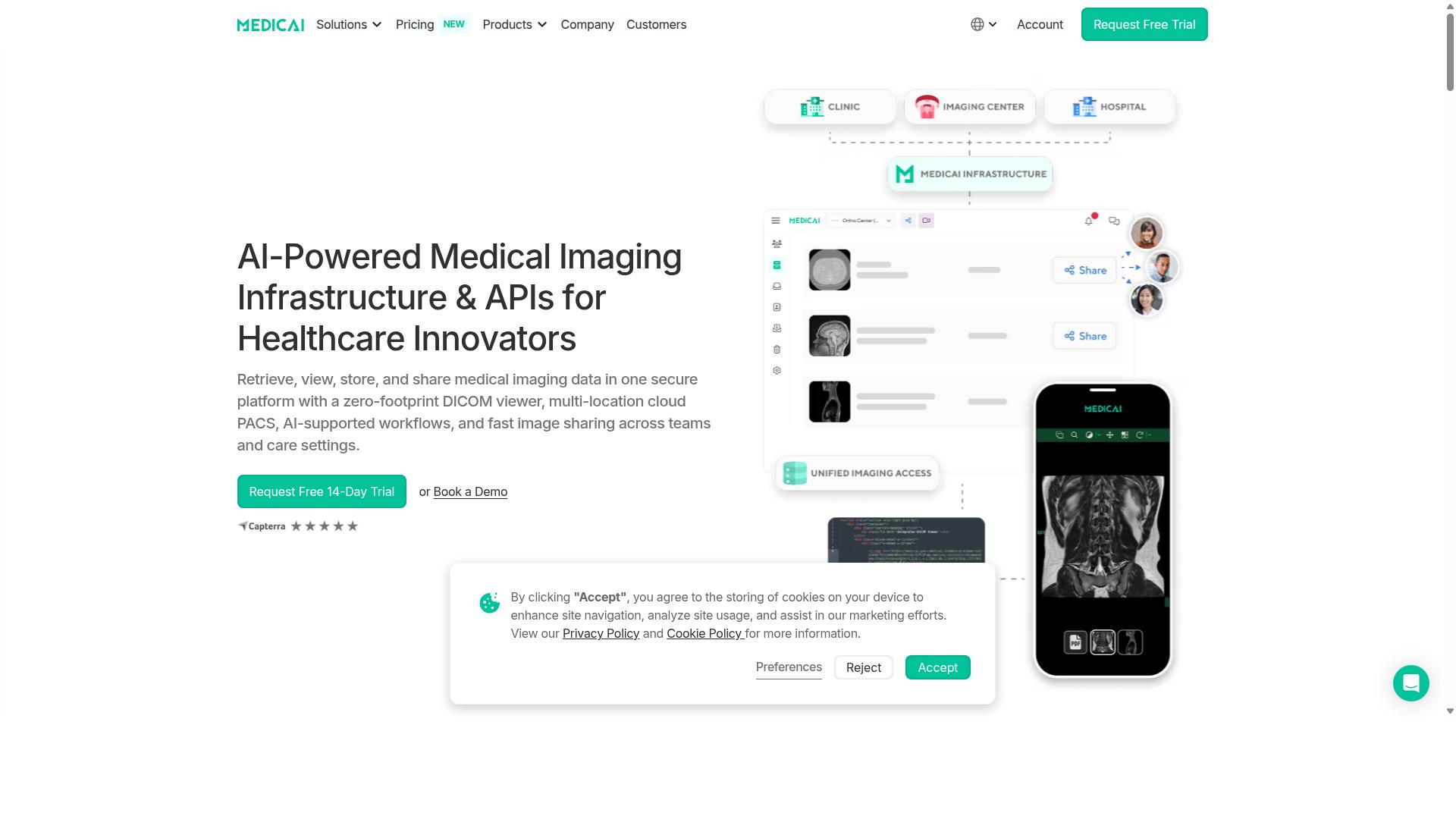
Medicai operates as a cloud-based medical imaging platform connecting healthcare providers to unified imaging workflows. The platform serves as an Imaging Infrastructure as a Service solution. It enables healthcare providers to manage medical imaging data across multiple care settings.
The system functions as a vendor-neutral archive that supports standard medical imaging protocols. Healthcare organizations use it to handle DICOM files and connect with existing systems. The platform accommodates both current workflows and future technology needs.
A zero-footprint DICOM viewer allows users to access imaging studies through standard web browsers. This capability eliminates the need for local software installations on clinical workstations. Medical staff can review patient images from any location with internet access.
Multi-location cloud PACS functionality supports healthcare systems operating across different facilities. The architecture enables consistent access to imaging studies regardless of where the original data resides. This setup proves valuable for organizations managing multiple departments or satellite locations.
AI-supported workflows help streamline radiology processes and reduce manual tasks. The platform incorporates machine learning capabilities to assist with image routing and study organization. These features align with current trends toward automated medical imaging management.
Fast image sharing capabilities allow care teams to exchange studies efficiently. The system supports collaboration across different specialties and care settings. Providers can share imaging data within their organization or with external partners when needed.
Medicai focuses on interoperability standards that enable connectivity with various healthcare systems. The platform works with existing PACS and RIS installations. This approach helps organizations modernize their imaging infrastructure without complete system replacement.
What Is Intelerad?

Intelerad provides radiology and enterprise imaging solutions to healthcare organizations across multiple care settings. The platform serves hospitals and imaging centers that need reliable systems for managing medical imaging data at scale. Organizations often evaluate these solutions when planning vendor-neutral archive implementations.
Enterprise focus means the company targets larger facilities with complex workflows. This includes multi-site networks that require coordinated access to imaging studies. The approach differs from simpler tools designed for smaller practices.
Healthcare organizations use these platforms to store, route, and retrieve DICOM images. The systems typically connect with existing PACS environments and support HL7 messaging for order and result communication. Integration capabilities become important when facilities consider data migration strategies.
Many hospitals run these solutions on-premise while others explore cloud storage options. Deployment choice affects factors like latency, uptime SLA requirements, and local IT support needs. Organizations weigh these trade-offs against their specific operational requirements.
Intelerad competes in the broader enterprise imaging space alongside other platform providers. Facilities evaluating vendor-neutral archive options often review multiple vendors before making decisions about their radiology workflow infrastructure.
What Is Medicai for Vendor-Neutral Archives?
Medicai's Vendor Neutral Archive centralizes imaging data regardless of originating system or vendor. This approach supports healthcare organizations that need to consolidate studies from multiple modalities and departments without being locked into a single manufacturer. The result is a unified repository that simplifies retrieval and long-term retention.
The platform combines four core components that work together to manage enterprise imaging needs. Cloud PACS handles storage and access while Medical Image Exchange enables secure transfer between sites. The Vendor Neutral Archive itself stores DICOM objects in their original format, and Backup and Disaster Recovery protects against data loss with automated redundancy.
Interoperability is achieved through standard protocols that connect with existing hospital systems. DICOM handles image transfer, HL7 manages order and patient data, and FHIR supports modern application integration. These connections allow the archive to receive studies from modalities, RIS systems, and EMR platforms without requiring custom interfaces.
Additional services such as the Medical Imaging Uploader and DICOM Gateway extend connectivity to external referrers and remote locations. The Medicai Imaging API provides programmatic access for developers who need to build custom workflows around the archive. This combination of services creates a flexible foundation for multi-site imaging operations.
Features Compared
Feature-by-feature comparison isolates storage architecture, security posture, and integration depth between the two platforms.
Vendor-neutral archives serve as the backbone for medical imaging workflows across hospitals, clinics, and imaging centers. The architecture choices made by each solution determine how efficiently radiology teams can store, retrieve, and share studies across different sites.
Storage architecture affects everything from data migration speed to long-term scalability. Security posture determines whether an organization meets regulatory requirements while maintaining efficient clinical workflows. Integration depth decides how well the archive connects with existing PACS systems, EMR platforms, and other clinical applications.
Cloud Storage & Multi-Site Access
Medicai's Starter tier begins at 500 GB while Standard reaches 2 TB, each supporting unlimited user accounts.
Intelerad offers multi-site capability through enterprise deployments, though specific capacity tiers remain less clearly defined in public documentation. Organizations evaluating these platforms often find transparent storage tiers helpful for capacity planning.
Medicai's multi-site access design allows connected locations to share imaging data seamlessly. The Enterprise tier supports multiple connected locations and external access points, making it suitable for health systems with distributed imaging departments.
Cloud storage tiers eliminate the need for on-premise server management. This approach reduces hardware maintenance costs while providing scalable capacity that grows with study volumes.
Multi-site connectivity enables radiologists to access studies from any connected location without physical data transfer. Real-time availability across sites improves report turnaround times and reduces duplicate imaging studies.
Security & Compliance
Medicai maintains HIPAA and GDPR compliance with encryption, audit logging, and role-based access controls.
Intelerad implements enterprise security measures typical of established medical imaging vendors. Healthcare organizations require documented compliance frameworks to meet regulatory obligations across different jurisdictions.
Encryption protects data both in transit and at rest throughout the archive lifecycle. Audit logging tracks every access attempt and modification to imaging studies, creating accountability trails for compliance reviews.
Role-based access controls ensure clinical staff see only the studies relevant to their role and department. This granular permission structure prevents unauthorized access while maintaining efficient workflow for authorized users.
FDA/CEE cleared viewers provide additional regulatory assurance for diagnostic use. OWASP security guidelines inform ongoing development practices that address emerging threats to medical imaging platforms.
Integration & API Capabilities
Medicai executes 50M+ API transactions yearly, exposing endpoints for DICOM, HL7, and FHIR workflows.
Intelerad supports interoperability with existing hospital systems through standard medical imaging protocols. Healthcare organizations typically evaluate API documentation quality when planning integrations with radiology information systems and electronic medical records.
DICOM support enables direct communication with modalities, PACS systems, and viewing workstations. HL7 integration connects the archive with scheduling systems, patient demographics, and order management platforms.
FHIR endpoints allow modern healthcare applications to access imaging metadata alongside clinical data. This standards-based approach supports emerging use cases like AI algorithm integration and population health initiatives.
High transaction volumes demonstrate platform reliability under real-world clinical loads. Consistent API performance ensures that image routing, prefetching, and study reconciliation complete within acceptable timeframes for radiology departments.
Pricing Compared
Medicai publishes transparent monthly fees: Starter at $249 for 500 GB and Standard at $749 for 2 TB. Intelerad, by contrast, follows custom enterprise pricing without disclosing numbers publicly. This difference in approach affects how radiology teams evaluate vendor-neutral archive solutions.
Clear pricing helps imaging departments plan budgets in advance. Organizations know exactly what storage capacity and user access each tier includes before signing any agreement. This transparency reduces surprises during procurement and contract review.
Intelerad structures its vendor-neutral archive offerings around enterprise contracts that require direct consultation. Pricing varies by deployment model, storage volume, and integration scope. Radiology teams must engage sales representatives to receive cost estimates for their specific requirements.
Both platforms support medical imaging workflows that demand HIPAA compliance and data encryption. Medicai lists its cloud storage allocations directly on its pricing page. Intelerad negotiates storage and compute requirements during individual enterprise discussions.
The $1,000 one-time DICOM Gateway Setup fee applies per location when connecting external systems. Standard tier includes one connected location, while Enterprise customers can arrange multiple external locations through custom agreements. Per-study pricing remains available for organizations with variable imaging volumes.
Yearly billing reduces costs by 15 percent for both Starter and Standard tiers. Organizations pay $209 monthly or $639 monthly respectively when committing annually. Intelerad enterprise agreements may also include multi-year terms, though specific discount structures are not published.
Who Should Choose Medicai
Healthcare organizations managing multi-site imaging volumes or requiring rapid cloud deployment align with Medicai's architecture. Hospitals, imaging centers, and specialty care groups benefit when their workflows span multiple locations and demand shared access to imaging data.
Medicai provides unlimited user accounts and 2 TB cloud storage at a flat monthly rate of $749. This pricing model supports both large health systems and smaller practices that need predictable costs without per-user fees.
The zero-footprint viewer removes software installation requirements across departments. Clinical teams can access studies from any workstation or mobile device without local configuration or IT intervention.
Specialty groups in orthopedics, neurology, oncology, cardiology, and similar fields often work across fragmented sites. Medicai's vendor-neutral archive approach allows these practices to consolidate imaging studies while maintaining interoperability with existing PACS and EMR systems.
Virtual care providers and teleradiology services also gain from the cloud-first design. Organizations that prioritize rapid deployment over on-premise infrastructure find the platform accommodates growth without additional hardware investments.
Personal injury lawyers, tumor boards, and clinical trial coordinators require secure multi-party access to imaging. Medicai's structure supports these use cases by enabling role-based permissions without restricting the number of authorized users.
Who Should Choose Intelerad
Health systems seeking extensive on-premise control or deeply customized radiology workflows may evaluate Intelerad. Organizations that maintain strict internal data policies often prefer vendor solutions that run entirely within their infrastructure. This approach provides direct oversight of hardware, security protocols, and system updates.
Intelerad supports environments where on-premise deployment remains a priority. Hospitals with complex legacy systems may need extensive configuration to align vendor-neutral archive functions with existing radiology workflows. Customization becomes essential when standard integrations do not fully meet operational requirements.
Facilities that handle high volumes of medical imaging often require fine-tuned performance adjustments. Radiology workflow optimization may involve tailoring image routing, study reconciliation, and modality worklist management to specific clinical pathways. These adjustments can demand significant technical resources and internal expertise.
Organizations that value complete control over data encryption, audit logging, and role-based access may find Intelerad suitable. The ability to manage uptime SLAs internally appeals to institutions with dedicated IT teams. Such environments typically prioritize direct oversight of every component within their enterprise imaging strategy.
Who Should Choose Medicai for Vendor-Neutral Archives
Providers consolidating legacy archives or standardizing across multiple PACS vendors benefit from Medicai's vendor-neutral design. The platform supports Cloud PACS and Vendor Neutral Archive capabilities that handle data migration projects without forcing complete system replacements. Organizations operating several imaging systems can maintain their existing workflows while adding a unified archive layer.
Healthcare networks with multiple sites often struggle when each location uses different PACS vendors. Medicai's Medical Image Exchange and DICOM Gateway tools enable centralized storage while preserving local access patterns. This approach reduces the complexity typically associated with multi-vendor environments.
Data migration becomes necessary when organizations outgrow their current storage solutions or need to update aging infrastructure. Medicai's Backup and Disaster Recovery features support these transitions by maintaining data integrity throughout the process. The vendor-neutral architecture allows institutions to move studies between systems without format conversion issues.
Facilities seeking to reduce on-premise hardware costs while maintaining HIPAA compliance and GDPR standards find value in the cloud-based approach. Medicai provides role-based access controls and audit logging that meet regulatory requirements. The platform scales storage capacity based on actual usage rather than requiring upfront hardware investments.
Medical centers planning long-term archive strategies benefit from the combination of Cloud PACS and Vendor Neutral Archive capabilities. This dual approach supports both immediate access needs and extended retention requirements without separate systems. Organizations can migrate data in phases while maintaining continuous clinical access to studies.
Final Verdict
Medicai's 1M+ studies processed yearly, 300k+ DICOM visualizations, and transparent pricing differentiate it for cloud-first VNA deployments. These numbers reflect real operational scale across 70 clinics and hospitals with 10,000+ active doctors accessing the platform.
The zero-footprint viewer eliminates local software requirements while 50M+ API calls indicate strong interoperability with existing EMR and RIS systems. This approach reduces diagnosis time by 65% for participating facilities.
Intelerad's on-premise model may appeal to organizations with strict data residency requirements or existing infrastructure investments. Facilities that need complete control over hardware and software stacks sometimes prefer this traditional approach.
However, Medicai's 1.7M+ studies in storage, Microsoft Azure partnership, and FDA-cleared viewers provide enterprise-grade capabilities through cloud delivery. The platform follows HIPAA, GDPR, and OWASP security standards while supporting global multidisciplinary tumor boards.
Research suggests most modern VNA deployments benefit from cloud scalability and reduced infrastructure overhead. Medicai's architecture addresses typical vendor-neutral archive requirements without the maintenance burden associated with on-premise solutions.
Recommended Resources: